Self-QC Starts with Safety
The act of administering Testosterone Cypionate is the moment the user assumes the risk of bacterial infection, tissue damage, and nerve injury. Injectable oil-based hormones, particularly from grey-market sources, demand a strict, sterile protocol to prevent complications like abscesses or permanent scar tissue (fibrosis).
This guide addresses two core areas of injection safety:
- Technique Comparison: Detailed protocols for the two primary administration routes: Intramuscular (IM) and Subcutaneous (SubQ).
- Harm Reduction: Mandatory site rotation strategies and needle selection to prevent the most common long-term side effects.
Learn more about testosterone with our ultimate Canadian TRT guide
IM vs. SubQ Injection Routes
While Testosterone Cypionate is officially approved for IM injection, contemporary practice and recent clinical data confirm the SubQ route is equally effective for maintaining stable testosterone levels and is often safer and more comfortable.
Feature | Intramuscular (IM) Injection | Subcutaneous (SubQ) Injection |
Needle Placement | Deep into a muscle (e.g., glute, vastus lateralis). | Into the fatty tissue layer just beneath the skin (e.g., abdomen, thigh). |
Needle Size | Longer (1″ – 1.5″) and Thicker (21-23 Gauge). | Shorter (5-8″) and Thinner (25-27 Gauge). |
Pharmacokinetics | Higher peaks and lower troughs, leading to greater hormonal fluctuation (and potentially higher (E2/HCT). | Slower, more stable absorption, resulting in a lower peak-to-trough ratio. |
Comfort/Risk | More painful, higher risk of hitting a nerve or blood vessel. | Less painful, easier to self-administer, lower risk of muscle damage. |
Volume Limit | Can handle larger volumes (up to 3ml). | Limited volume (0.5ml) max, ideally less than 0.4ml. |
Recommended Use | Infrequent dosing (e.g., once weekly). | Frequent dosing (e.g., every other day or three times weekly). |
Needle Selection and Sterilization
Using the wrong needle size is the most common cause of pain, tissue damage, and anxiety. All injection protocols require two separate needles: one for drawing up (mixing), and one for injecting.
Mandatory Needle Selection Checklist
Purpose | Needle Size (Gauge/Length) | Rationale |
Drawing Up (Mixing) | 18 Gauge (1″ – 1.5″) | Wide gauge allows thick, oil-based T Cypionate to be rapidly drawn from the vial, minimizing stress and contamination risk. |
IM Injection | 22-23 Gauge (1″ – 1.5″) | Long enough to reach deep muscle; wide enough for oil to pass comfortably. Length adjusted for body fat percentage. |
SubQ Injection | 25-27 Gauge 5 8″ | Thinnest size minimizes pain; short length ensures delivery into the fat layer, not muscle. |
The Sterile Technique: Avoiding Infection
Infection is always a risk with unsterile equipment or poor technique. Follow this four-step process rigorously:
- Hand Hygiene: Wash hands thoroughly with soap and water for 20 seconds.
- Vial Cleaning: Clean the rubber stopper (septum) of the Test Cypionate vial with an alcohol swab in one direction, then let it air dry completely (15 seconds). Never touch the septum after cleaning.
- Needle Swap: Draw the medication with the wide 18G needle, then immediately remove it and discard it in a sharps container. Swap to the clean, small injection needle (25G-27G for SubQ or 22G for IM).
- Site Cleaning: Clean the chosen injection site with a fresh alcohol swab, using a firm swipe in one direction. Allow the alcohol to air dry completely before injecting. Injecting while the site is still wet causes a stinging sensation.
The Injection Protocol
A. Subcutaneous (SubQ) Protocol (Recommended for frequent dosing)
- Site Selection: The lower abdomen (away from the navel) or the upper, outer thigh are preferred sites.
- Pinch and Inject: With your non-dominant hand, firmly pinch a fold of skin and fatty tissue (1 inch fold) at the cleaned site.
- Insertion: Insert the 5 8” needle (25-27G) at a 90-degree angle with a quick, dart-like motion into the center of the pinched fold.
- Aspiration (Optional but Recommended): Gently pull back the plunger for a few seconds. If you see blood, you’ve hit a small vessel; withdraw the needle immediately and discard it, then prepare a new injection at a new site.
- Inject and Withdraw: Slowly push the plunger to empty the syringe. Wait 5 seconds, then remove the needle at the same angle, and release the skin fold. Apply light pressure with a fresh cotton ball.
B. Intramuscular (IM) Protocol
- Site Selection: Vastus Lateralis (Outer Thigh) for self-injection, or Dorsogluteal (Upper, Outer Quadrant of the Buttock) if administered by another person.
- Stretch and Inject: Stretch the skin tight around the injection site with your non-dominant hand.
- Insertion: Insert the long IM needle (21-23G, 1″–1.5″) at a 90-degree angle with a quick, firm motion, almost the entire length of the needle.
- Aspiration (Mandatory): Gently pull back the plunger for several seconds. If blood is drawn, remove the needle immediately, discard, and restart at a new site.
- Inject Slowly: Inject the oil slowly (approx. 10 seconds per 1 ml) to minimize pain and muscle irritation.
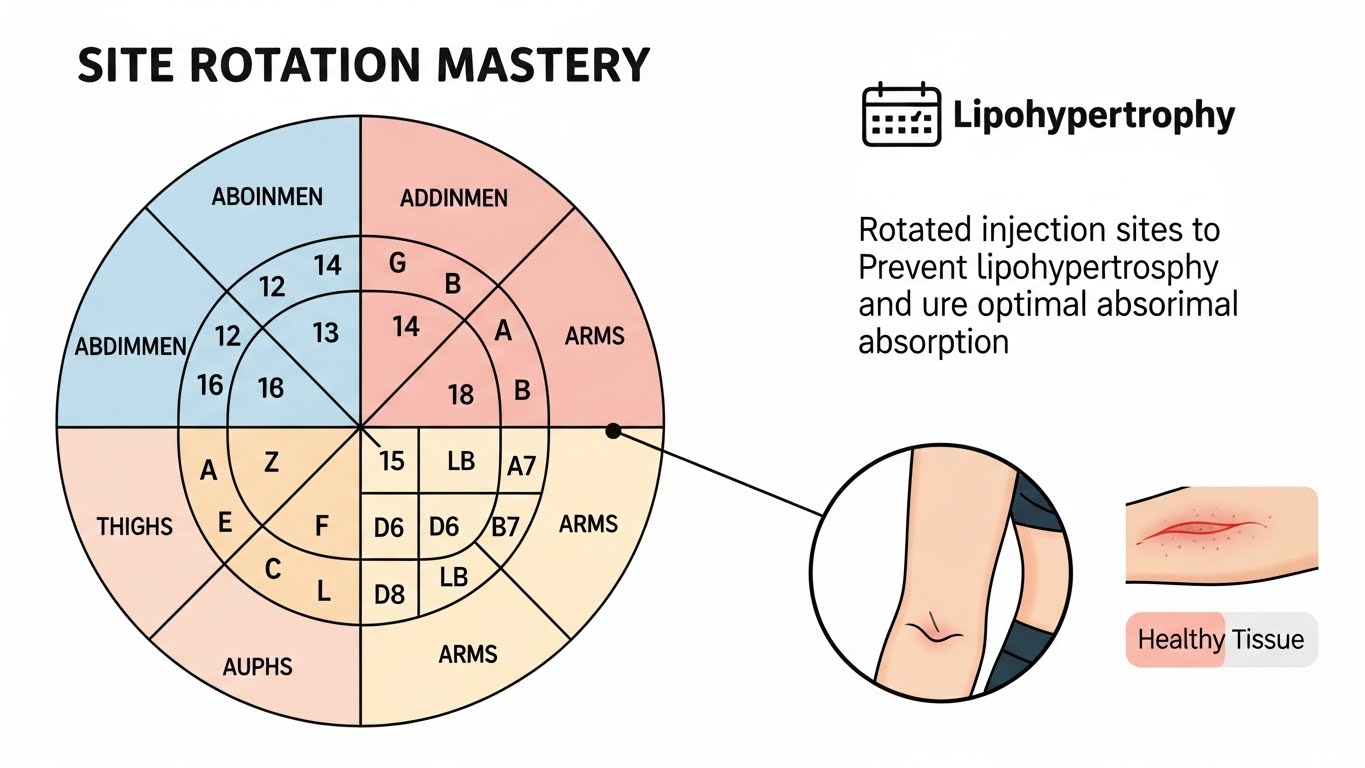
Mandatory Site Rotation Guide
Repeated injections into the same small area cause scar tissue (fibrosis), which impairs the absorption of the oil and can lead to painful lumps, calcification, and potentially cysts. You must rotate injection sites with every dose.
Rotation Strategy:
- Rule: Never inject the same spot twice in a 14-day period. Ensure each new injection is at least 1 inch away from the last.
- SubQ Rotation: Use the abdomen and both thighs.
- Abdomen: Divide the area into quadrants and rotate in a clockwise spiral, avoiding the navel and bone.
- Thighs: Use the fatty outer upper thigh, alternating between left and right.
- IM Rotation: Use the largest muscles available.
- Left Thigh (Vastus Lateralis) Right Thigh, Left Glute (Upper-Outer Quad) Right Glute.