


When sourcing Testosterone Cypionate from any unregulated or grey-market provider, the most critical factor is safety. You are relying on a supplier’s claim about what is in the vial. Without a prescription, that product lacks the oversight of Health Canada.
This is why independent, third-party laboratory analysis is the mandatory minimum standard for harm reduction.
The two primary analytical techniques used to confirm a steroid’s safety, identity, and potency are:
This guide explains what each test measures and how to interpret a full lab report, turning an opaque process into a transparent one.
Learn more about testosterone with our ultimate Canadian TRT guide
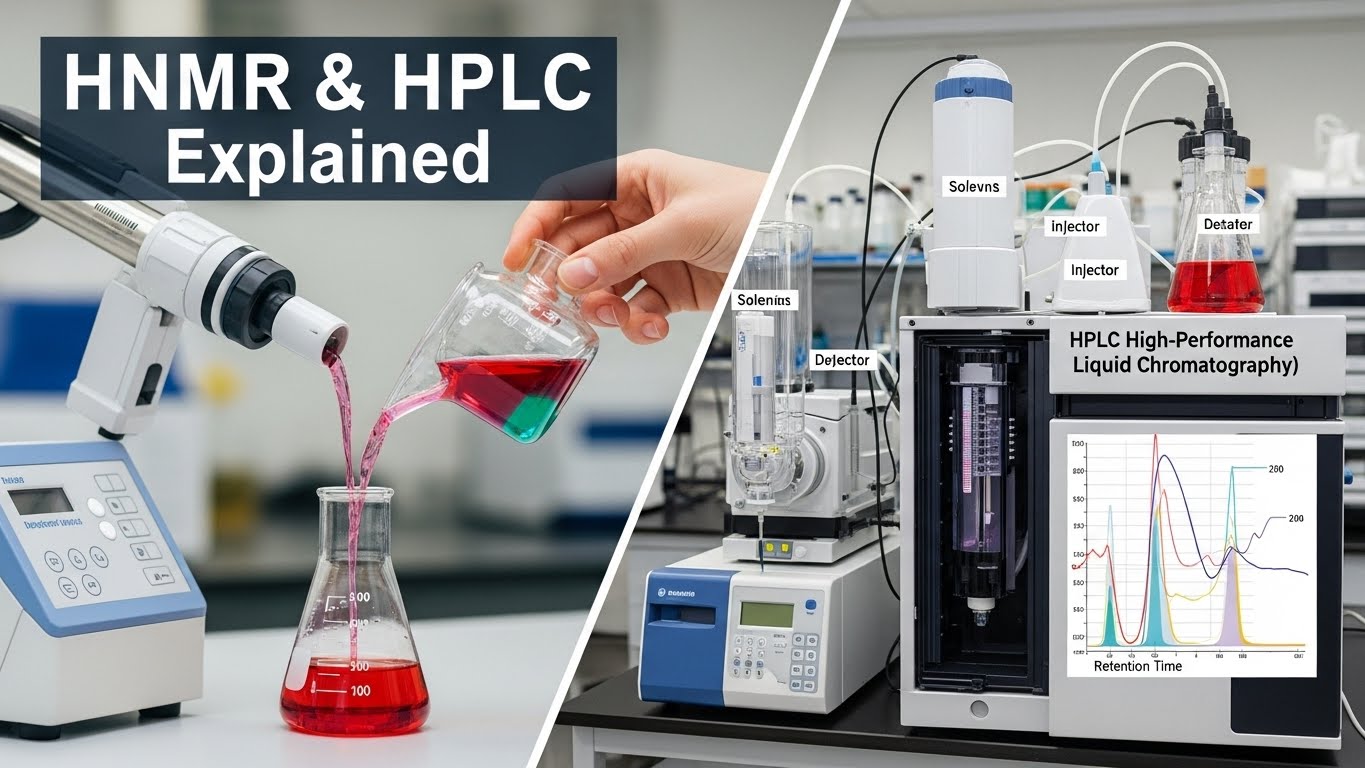
HPLC is a technique that separates components in a liquid mixture, allowing scientists to identify and quantify them with extreme accuracy. For Testosterone Cypionate, this is the test that answers the question: “How much active TC is there, and what else is in the bottle?”
The result is a graph called a chromatogram, which looks like a series of peaks on a timeline.
Chromatogram Feature | What It Represents | Significance for the User |
Retention Time | The specific time (in minutes) a substance takes to exit the column. | Identity: This confirms the peak is Testosterone Cypionate. The time must match a known standard. |
Peak Area | The total area under the peak. This is proportional to the concentration of the substance. | Concentration: This is used to calculate the final dose (e.g., 250\mg/mL or 238mg/mL). |
Impurity Peaks | Any peaks that appear before or after the main T C peak. | Purity: These are counted as “not the intended drug.” The ratio of the main peak area to the total peak area gives the purity percentage. |
Mandatory Minimum: A quality T C product should show an HPLC purity percentage of 98%. Any lower indicates significant contamination or degradation.
While HPLC is excellent for separation, it cannot definitively tell you if the substance is structurally correct (e.g., if it’s TC vs. a similar molecule like Testosterone Enanthate) or if non-UV active contaminants like solvents are present. This is the job of HNMR.
HNMR uses a powerful magnet and radio waves to map the magnetic properties of hydrogen nuclei (protons) in the molecule.
Key HNMR Output: A passing HNMR result provides two critical pieces of information: 100% Structural Match (Identity) and a highly accurate Absolute Purity Score.
Relying on just one test leaves critical gaps in the safety profile of the substance:
If you only have… | The Hidden Risk Is… |
Only HPLC | The active ingredient might be structurally incorrect (e.g., a non-psychoactive isomer of TC), or the HPLC machine was programmed to ignore major non-UV active solvent peaks. |
Only HNMR | The substance is structurally correct, but the HNMR test is often less sensitive for detecting minute traces of solid, non-solvent-related impurities (by-products) that HPLC is built to find and quantify. |
The Gold Standard: A reliable supplier will provide a comprehensive report showing a clear HPLC chromatogram confirming high concentration and purity, alongside the HNMR spectrum confirming the substance’s perfect molecular identity.
Before trusting any grey-market source, verify that their third-party testing reports meet these standards:
By understanding the difference between the HPLC Purity Profile and the HNMR Identity Confirmation, you can make the most informed, harm-reduced decisions possible when interacting with unregulated substances.
Further Reading: The chemical risks associated with unverified products are closely linked to the legal risks: CDSA Schedule IV Explained: The Legal Guide for Canadians