



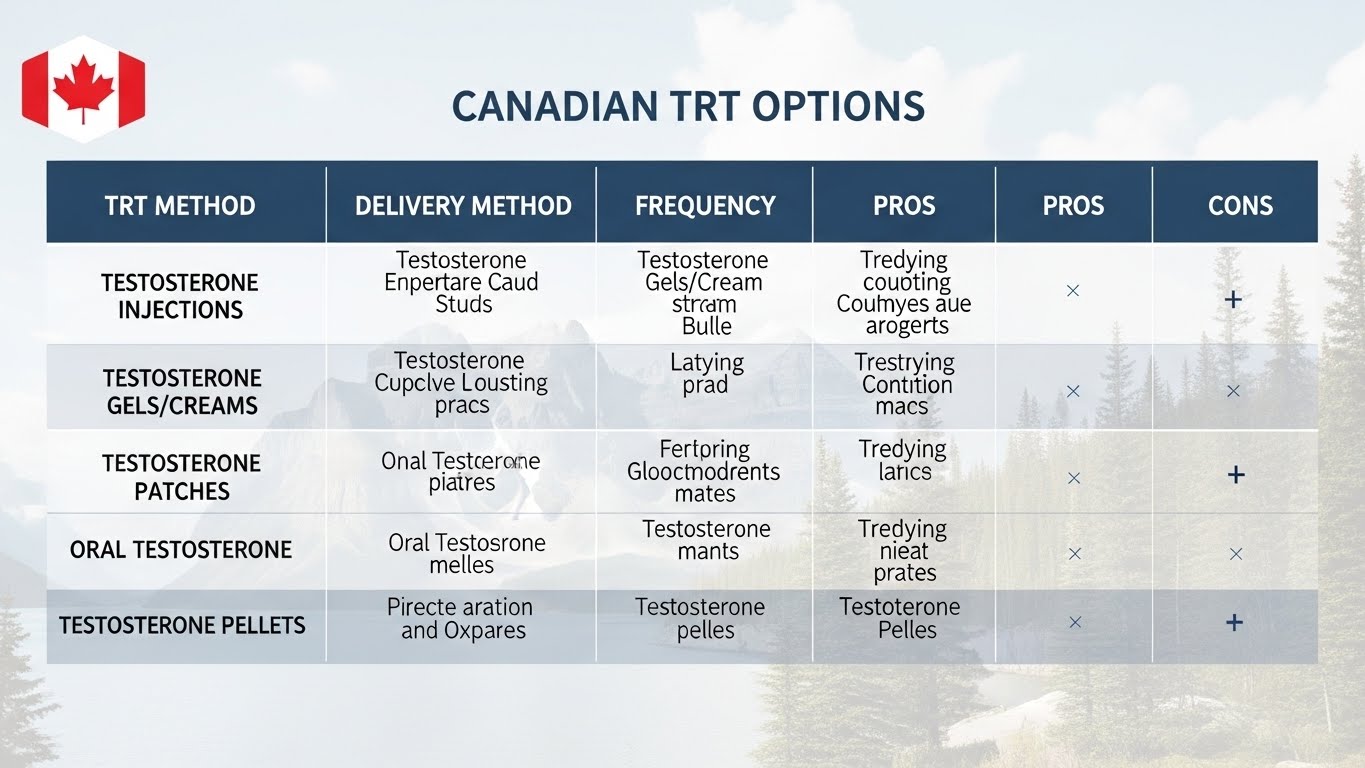
Testosterone Cypionate is just one of many forms of testosterone. All injectable testosterone drugs are chemically identical; the difference lies only in the ester, a carbon chain attached to the testosterone molecule. This ester acts like a timed-release mechanism, delaying absorption from the muscle or fat tissue into the bloodstream.
Understanding the difference between the available esters and delivery methods is crucial for two reasons:
Learn more about testosterone with our ultimate Canadian TRT guide
For frequent, self-administered injections, Cypionate and Enanthate are nearly interchangeable in practice. Their differing half-lives only become relevant if dosing is stretched too thin.
Feature | Testosterone Cypionate (T C) | Testosterone Enanthate (T E) |
Common Name | Depo-Testosterone (US), Taro-Testosterone (Canada) | Delatestryl (Canada) |
Half-Life | approx 8 days | approx 5 days |
Peak Absorption | approx 48 hours post-injection | approx 24 hours post-injection |
Dosing Frequency | 3 to 7 days (Recommended for stability) | 3 to 7 days (Recommended for stability) |
Absorption Speed | Slightly slower release due to a longer carbon chain. | Slightly faster release due to a shorter carbon chain. |
Key Takeaway | Practically identical to T E when injected frequently (e.g., twice weekly). | Practically identical to T C when injected frequently (e.g., twice weekly). |
Pharmacokinetic Note: While the half-lives differ, injecting both TC and TE at least twice weekly (e.g., Monday morning and Thursday evening) minimizes the difference, providing a stable, near-daily level of testosterone. This stability is key to preventing the E2 (Estrogen) and HCT (Hematocrit) spikes associated with the “roller coaster” protocol, as discussed in the guide: Blood Work Explained: Reading Your Total T, Free T, SHBG, and Lipid Panel
These alternatives serve specific use cases and are often explored in a clinical setting to address patient discomfort or adherence issues.
This is the longest-acting ester, designed to minimize injection frequency.
This delivery method bypasses injections entirely, using a topical gel absorbed through the skin.
The choice of ester is less important than the frequency of administration. When attempting to maximize the use of Testosterone Cypionate, high frequency is necessary to achieve the hormonal stability that mitigates critical side effects.
Side Effect | Mechanism of Mitigation via Frequent Dosing |
High E2 / Gynecomastia | Frequent, smaller doses reduce the high hormonal peaks that trigger excessive aromatase conversion, thereby stabilizing E2 and reducing the need for Aromatase Inhibitors (AIs). |
Polycythemia / High $\text{HCT}$ | Reduces the intensity of the RBC production signal (erythropoiesis) that occurs at high T peaks, helping to keep Hematocrit below the 52% danger zone. |
Mood/Energy Fluctuation | Stable serum levels eliminate the sharp mood and energy “crashes” that often occur in the days leading up to an infrequent (e.g., 14-day) injection. |
Final Recommendation: While Testosterone Cypionate is the base product, for optimal safety and stability, it should be treated with a high-frequency protocol, using either the IM or, preferably, the easier-to-manage SubQ route, as outlined in the guide: Safe Injection Techniques: IM vs. SubQ Protocol & Site Rotation Guide