



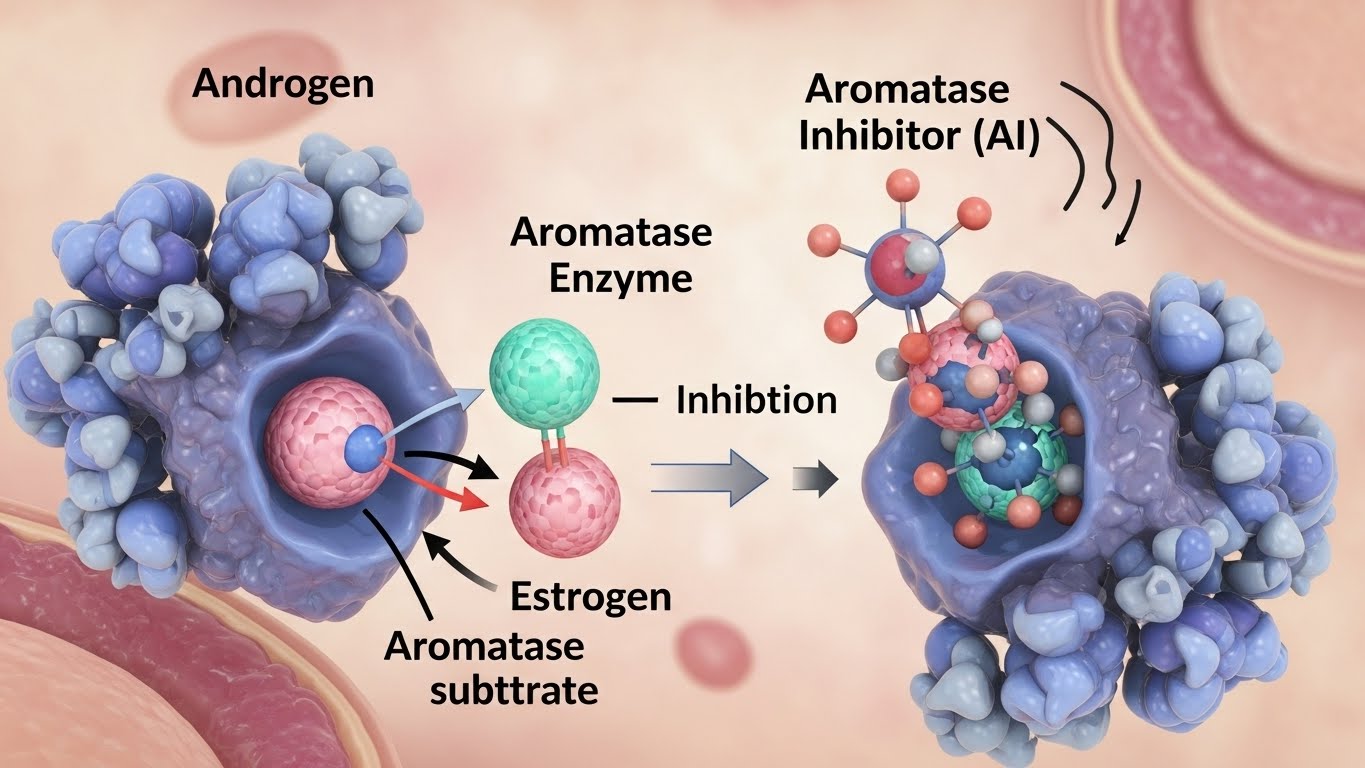
When exogenous Testosterone Cypionate is introduced into the body, a percentage of it is converted into the primary female sex hormone, Estradiol (E2), via the Aromatase enzyme. This process, known as Aromatization, is natural, but high supraphysiological levels of T can lead to excessively high E2.
Aromatase Inhibitors (AIs) are prescription-only drugs used to block the action of this enzyme, thereby reducing the production of E2. They are a high-risk management tool and should never be used blindly without recent, high-sensitivity E2 blood testing.
Learn more about testosterone with our ultimate Canadian TRT guide
The goal is not to eliminate E2, but to keep it in a healthy, controlled range (the “Goldilocks” zone). Both high and low E2 levels are detrimental to health and well-being.
High E2 signals your body to retain water and can increase blood pressure, but the most concerning risk is the development of breast tissue.
Symptom | Risk/Mechanism |
Puffiness/Bloating | Excessive water retention/fluid shift. |
Nipple Sensitivity | Tenderness, itchiness, and puffiness around the areola (the first stage of Gynecomastia). |
Mood Swings | Emotional volatility, anxiety, or depression. |
High Blood Pressure | Increased fluid volume and peripheral vasoconstriction. |
Libido Loss | Paradoxical effect where excessive E2 can suppress LH/FSH signals. |
Over-dosing an AI and crashing E2 is arguably more immediately debilitating than high E2.
Symptom | Risk/Mechanism |
Severe Joint Pain | E2 is crucial for lubricating joints and ligaments. |
Lethargy/Fatigue | General feeling of illness, exhaustion, and cognitive fog. |
Profound Libido Loss | A complete loss of sex drive. |
Dry Skin/Eyes | Mucous membranes require E2 for moisture. |
Depression/Irritability | Significant negative shift in mood and psychological state. |
AIs fall into two pharmacological categories, and understanding the difference is essential for protocol stability.
The greatest mistake made by users is taking a set AI dose (e.g., 0.5mg twice weekly) regardless of their actual E2 level. This is reckless and leads to E2 crashes.
You must use a High-Sensitivity Estradiol Assay (often labeled E2, LC-MS/MS). The standard test is inaccurate at male E2 levels and may give a false low reading. Refer to the guide: Blood Work Explained: Reading Your Total T, Free T, SHBG, and Lipid Panel
Your blood work should confirm your E2 is in the safe, mid-physiological range. For most men on exogenous T, this target is 20–40pg/mL (73-147pmol/L).
After starting the low dose, you must wait 10-14 days and then get a new E2 blood test.
Result | Action |
E2 is >40pg/mL | Increase the AI dose slightly (e.g., from 0.25mg BIW to 0.375mg BIW). |
E2 is 20–40pg/mL | Maintain current AI dose. Re-test E2 every 4-6 weeks to ensure stability. |
E2 is <20pg/mL | STOP AI immediately. Wait one week, re-test E2, and monitor for joint pain/crashing symptoms. |